
Museum Topics: THE daimler CCG5
The Daimler CCG5 double-decker represents a fascinating chapter in British bus history, embodying the tail end of the era of traditional front-engine, half-cab double-deckers.
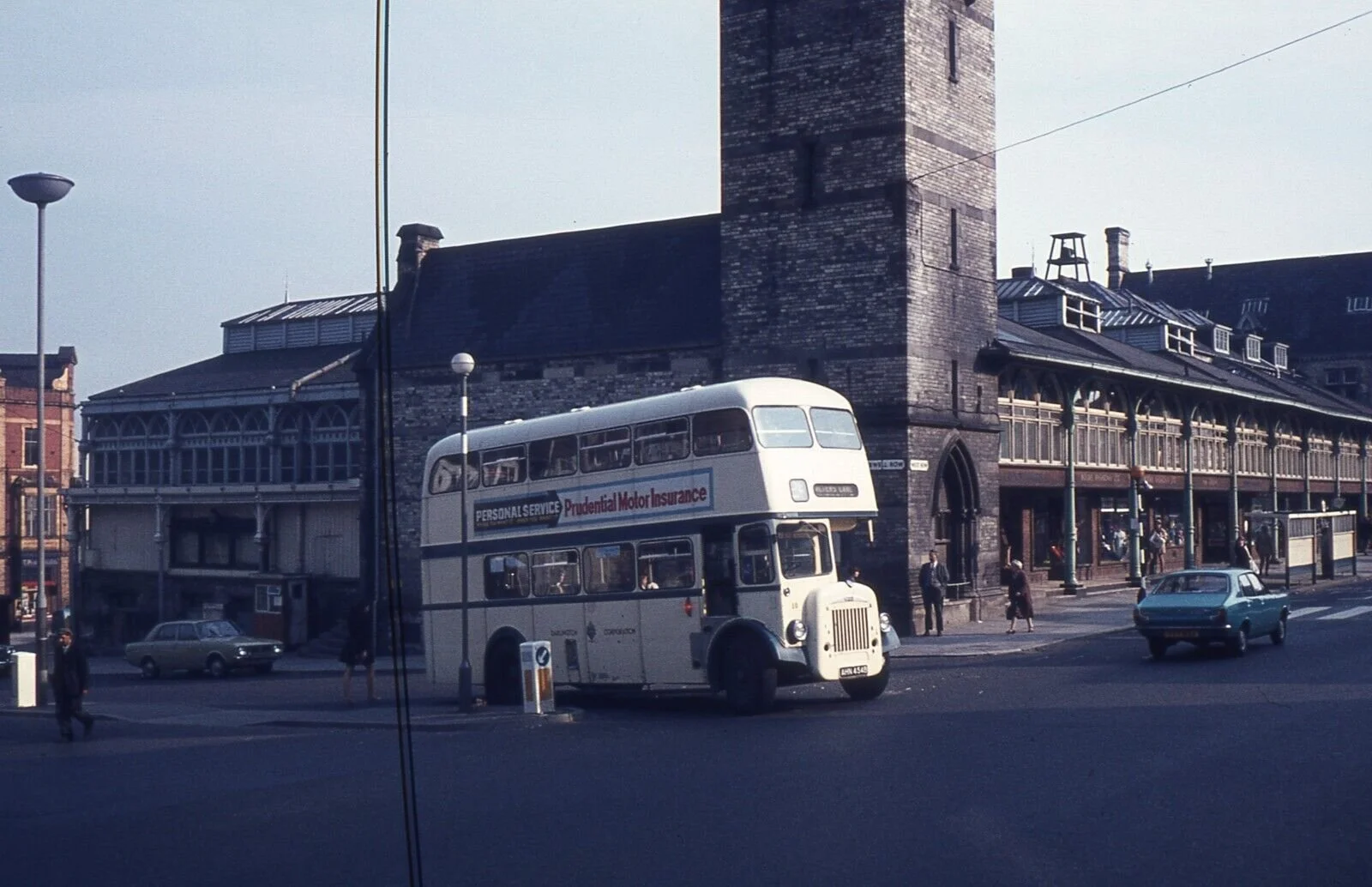
Daimler CCG5 Roe AHN 454B emerging from Tubwell Row on the Salters Lane service, 1972. - Keith Mountford-Eddy
Museum Topics: THE daimler CCG5
The Daimler CCG5 double-decker represents a fascinating chapter in British bus history, embodying the tail end of the era of traditional front-engine, half-cab double-deckers. Built during the 1960s, these buses were among the last of their kind before the rise of rear-engine, one-man-operated designs.
The CCG5 chassis was a Daimler creation, featuring a front-mounted engine and a half-cab driving position. The "CC" prefix indicates its derivation from Guy designs, while the "G5" refers to the robust Gardner 5-cylinder diesel engine commonly used. Many were fitted with a manual gearbox, making them reliable workhorses for municipal operators.
Operators often paired the CCG5 chassis with bodies from various coachbuilders. Massey bodied versions were common in East Staffordshire, while Charles Roe bodied examples served Darlington. The buses typically featured step-entrance designs and a rear open platform for passenger boarding, necessitating a driver and conductor team. This design, while traditional, was increasingly seen as old-fashioned during the 1960s.
The CCG5 found its primary use with UK municipal operators, serving local routes from the 1960s through the 1970s. Notable examples include Darlington Corporation Transport, which purchased a batch in 1964. East Staffordshire District Council also operated a significant number of CCG5s, many of which continued service into the early 1980s.
One preserved Darlington CCG5, fleet number 7, remains a popular exhibit at rallies, offering a tangible link to the era of half-cab double-deckers. The CCG5 stands as a symbol of the last generation of buses requiring a conductor, just before the transition to rear-engined models like the Daimler Fleetline and Leyland Atlantean, which enabled more economical one-man operation.
The Daimler CCG5 is more than a vehicle; it is a historical artifact that teaches us about mid-20th century public transport, engineering, and urban life. By exploring buses like the CCG5, visitors to Aycliffe Bus Museum can gain insight into the evolution of bus design and operation, appreciating both the technological advancements and the social context of the period.
The CCG5 serves as a reminder of a bygone era, celebrating the craftsmanship, engineering, and community role of buses in Britain’s transport history.